
TM30 Report for a Guesthouse in Thailand: Collect Once, File Fast
What the TM30 report means for a Thai guesthouse or hostel, what guest details it needs, and how to stop retyping passports by building the file from bookings.
The short answer
TM30 is the notification Thai Immigration expects from whoever hosts a foreign national in Thailand, and that includes guesthouses, hostels and hotels. It tells immigration where a foreign guest is staying. As it is commonly described, the property files it for each foreign guest within 24 hours of arrival, either online, in person at the local immigration office, or by whatever method your office accepts.
The slow part of TM30 is not the form. It is typing the same passport details a second time for every arrival. The fix is to collect those details once, at booking or at check-in, store them on the booking, and produce the TM30 file from the bookings you already have. The rest of this article covers what the report is for, who is responsible, which details you need, and how to set up that workflow.
A note before we go on: this is a practical guide from people who run guesthouses, not legal advice. Thai Immigration rules, deadlines, forms and local office practice can change, and offices sometimes differ in how they handle things. Confirm the current rule and deadline with Thai Immigration or your local immigration office before you build a process around anything below.
What TM30 is for
Thailand wants to know where foreign nationals are staying. TM30 is how the person or business hosting them reports it. It is a notification of residence, not a booking record, not a tax filing and not a guest registration for your own use. The authorities get an entry that says a particular foreign guest arrived at a particular address on a particular date.
It also affects your guests. Some guests are asked for proof of their TM30 record when they deal with immigration, for example during certain visa or extension procedures. So a missed or wrong filing can come back to you as an unhappy guest, not just a compliance problem.
Who has to file it
The duty generally sits with the host: the owner, the person in charge of the property, or the operator. For a guesthouse or hostel, that means you, or whoever you have authorised to do it. The guest is not the one expected to file when they stay with you.
- Foreign guests only. Thai nationals are not part of this.
- Per guest, not per booking. A booking for four foreign travellers means four sets of details, not one.
- Dorms count. Beds in a shared room are still individual guests with individual passports.
- Long stays and returns. Ask immigration how they want repeat stays, extensions and guests who leave and come back handled.
If you use a manager, an agent or a staffed front desk, decide who is the named person responsible for filing. Everyone assuming someone else did it is how reports get missed.
When it is due
The commonly quoted window is 24 hours from the guest's arrival. Treat that as a starting point, not as a ruling. Check the current deadline, and what counts as the start of the clock, with Thai Immigration. Also ask what happens if a guest arrives late at night, over a weekend or on a public holiday, because those are the situations where a busy front desk falls behind.
I am deliberately not quoting penalty amounts. They are set by the authorities and may change, so get them from the source.
What guest details you need
The exact fields depend on the current form and filing method, so check them against the live TM30 you actually use. In general, expect to need the following for each foreign guest:
- Full name as it appears in the passport
- Nationality
- Passport number
- Date of birth and gender
- Arrival date in Thailand and the date they arrived at your property
- Visa type or permitted stay details where the form asks for them
- Arrival-card or entry-record information where it applies
- Your property details and, usually, the room
The hard part is that most of this never reaches you with the booking. An OTA booking usually gives you a name, dates and a contact channel. It does not give you a passport number, and the name on the booking might be a nickname, a partner's name or a different spelling from the passport. So the passport itself has to be read at some point. The question is whether you type it once or three times.
Why retyping is the real problem
Here is how it commonly goes at a front desk that has no system for this:
- The guest arrives and hands over a passport.
- Someone photocopies or photographs it.
- Later, between other jobs, someone opens the immigration site or form and types the details from the photo.
- A typo in the passport number or a date format mismatch means a correction or a rejected entry.
- On a busy night with a full dorm, all this happens eight or ten times in a row.
None of those steps is difficult, but together they are slow, and every manual retype is a chance for an error that you only find out about later. A mistyped passport number is a worse mistake than a typo in a note field.
The workflow: collect once, build the file from bookings

The approach that works is the same regardless of what software you use:
- Capture the details one time, as close to arrival as possible, and attach them to the booking record, not to a spreadsheet or a photo folder.
- Keep each guest separate. Group bookings need one entry per foreign guest, including each bed in a dorm.
- Generate the TM30 file from the day's bookings instead of re-entering the data by hand.
- Check the file before you submit it. Look for missing passport numbers, odd dates and guests with no nationality recorded.
- Submit through the channel Thai Immigration accepts for your area and keep a record of what you sent and when.
You can do this with a spreadsheet and discipline. It breaks down when volume goes up or when different staff work different shifts, because each person has a slightly different habit.
Where a PMS fits in
We run guesthouses and Airbnb-style stays ourselves, and this is one of the jobs we built Kimchee PMS to take off the front desk. Here is what it actually does, and where it stops.
- It builds the TM30 file from the guest details on your bookings. For Thailand, the guest-reporting feature creates a TM30 file from the information stored with each reservation. This is in the Lite plan and up. You still submit the file to Thai Immigration yourself, and you still decide what is correct.
- On the Pro plan, guests can scan their own ID. Self check-in works through an ID scan with OCR, a room QR code or a front-desk kiosk. The scanned name is matched against the day's reservations. When the match is not confident, the system flags it for staff to check instead of guessing. Once matched, the screen shows the guest their room or bed number and access code in their own language.
- On Lite, your staff enter the details once at check-in or when they receive them, and that is the only time they are typed. The TM30 file is then generated without anyone retyping.
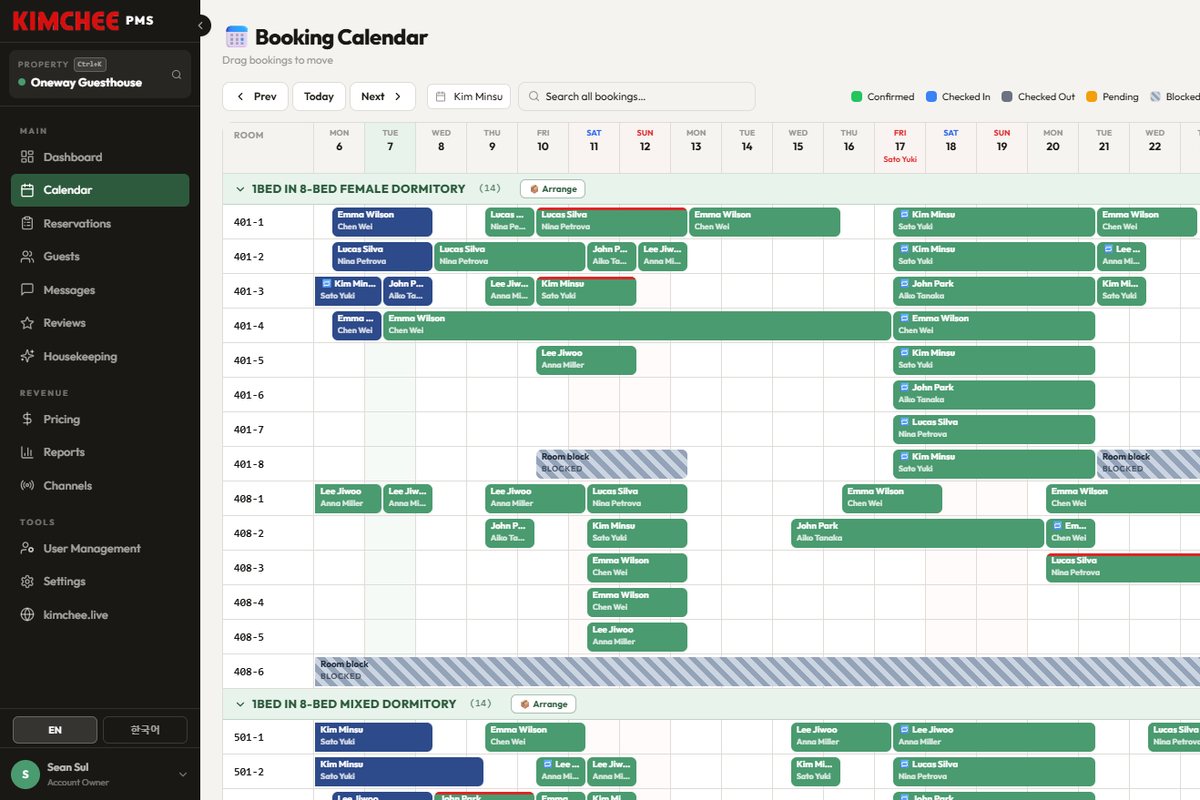
- Bookings from your channels land in one calendar. The channel manager is included, and connects channels such as Airbnb, Booking.com, Agoda, Hostelworld, Trip.com and Expedia, so the guest records live next to the reservation, not in a separate sheet. The full list is on the channels page.
What it does not do: it does not tell you what the law requires, and it does not replace checking the current rule with Thai Immigration. The file is a convenient output of your data. Whether a particular filing is right for a particular guest is your call, backed by the authority.
A sensible setup by guesthouse type
Dorm-heavy hostel
Many guests, many nationalities, many same-night arrivals. The scan-at-arrival route saves the most here, because there is a lot of volume and little time per guest. Make sure every bed holder has their own record, not just the person who made the booking.
Guesthouse with a few rooms
Fewer arrivals, but often one person at the desk doing everything. A once-a-day routine works: before a set time each evening, check that every foreign guest arriving that day has complete details, then generate and review the file.
Host with several units
If guests self-arrive with no one at a desk, you need the details before they get there or at a self check-in step. Decide what you do when a guest does not provide a passport. The answer should come from immigration guidance, not from improvising.
Questions to put to Thai Immigration
- What is the current deadline, and when does it start counting?
- Which filing methods does my local office accept: online, in person, or both?
- How should I handle guests who stay several weeks, extend, or leave and return?
- How should groups and dorm guests be reported?
- What should I do if a guest cannot or will not provide passport details?
- What do I do about a mistake after submission?
Write the answers down and put them in your staff handbook with the date you asked. Rules shift, so recheck now and then.
Getting started
If you want to see how the guest-reporting side fits with the rest of the system, the features page lists what is in each plan, and the FAQ covers common setup questions. For pricing, Lite starts at $45 and Pro at $70 for 1–10 rooms, shown in local currency in some countries. The PMS itself is free with no time limit; you only pay monthly for the channel manager, and the first month starts free once you connect your first OTA. Full tiers are on the pricing page.
If you run a Thai guesthouse or hostel and want to see the TM30 file built from your own bookings, see how Kimchee works and try it with your own reservations.
Run it on a system built by operators
Kimchee is the PMS our own team uses every day — we run guesthouses and Airbnb homes ourselves. The channel manager is included — no separate contract, no per-channel bill.